
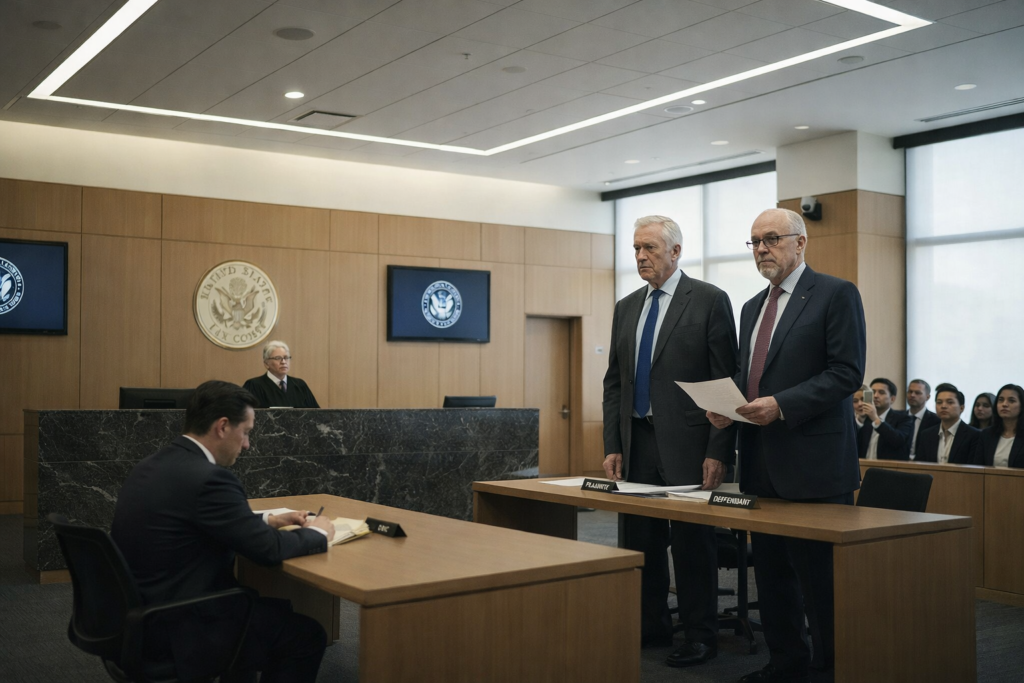
Form 5471 Penalty – Here’s a current summary of how Form 5471 penalties are being treated in the courts as of early 2026 — an important issue if you’re facing or contesting penalties under Internal Revenue Code §6038(b).
Table of Contents
Form 5471 Penalty – the Basics
Under IRC §6038(b), a U.S. person required to file Form 5471 (Information Return of U.S. Persons With Respect to Certain Foreign Corporations) faces:
- $10,000 penalty per tax year for failure to file timely,
- Additional $10,000 continuation penalties for ongoing failure after IRS notice,
- Up to $50,000 continuation cap for each failure period, plus the initial $10,000.
Historically, the IRS has automatically assessed these penalties via CP15 notices.
Key Court Cases (2023–2025)
There are a few recent court cases that have challenged the form 5471 penalty.
1. Farhy v. Commissioner (D.C. Cir., May 3 2024)
- The U.S. Court of Appeals for the D.C. Circuit overturned a Tax Court ruling and held that the IRS does have statutory authority to assess penalties under §6038(b) for willful failure to file Form 5471.
- This reversed an earlier Tax Court position that the IRS lacked such authority.
Implication: In the D.C. Circuit, the IRS may assess penalties administratively, meaning automatic CP15 assessments are lawful in that jurisdiction.
2. Mukhi v. Commissioner (U.S. Tax Court, Nov 18 2024)
- The Tax Court reaffirmed its view that the IRS lacks statutory authority to assess §6038(b) penalties administratively and must instead rely on civil litigation to collect them.
- This ruling arose even after the D.C. Circuit’s reversal in Farhy because the taxpayer’s appeal lies in a different circuit (likely the 8th Circuit).
Implication: In circuits outside D.C., Mukhi may control, creating a split of authority — meaning the IRS’s ability to assess penalties may depend on where the Tax Court appeal is heard.
3. Broader Tax Court Position
- The Tax Court’s rulings in Farhy and Mukhi consistently assert that §6038(b) does not include explicit language authorizing the IRS to assess and administratively collect these penalties in the same manner as taxes.
What This Means in Practice
How these cases have effected how the IRS can assess the form 5471 penalty.
Penalty Assessments
- The IRS continues to assess Form 5471 penalty nationwide (systems still issue CP15 notices).
- However, if challenged successfully in Tax Court in a jurisdiction outside the D.C. Circuit, you may argue the IRS lacks statutory authority to assess the penalty administratively.
Enforcement
- Even if the IRS can’t assess administratively under Tax Court precedent, it might still pursue penalties through a civil lawsuit (i.e., Department of Justice action), which is far more cumbersome for the IRS.
Circuit Split Risk
- Because the D.C. Circuit has sided with the IRS and the Tax Court in other circuits has not, there is a circuit split — which typically invites further appeals (potentially to a U.S. Court of Appeals or even the Supreme Court).
Compliance & Contesting Penalties
Even with these cases in play:
- The IRS is still assessing the form 5471 penalty by default.
- For most taxpayers, the traditional path remains:
- File the delinquent Form 5471,
- Request abatement with a reasonable cause statement,
- If assessed, file a CDP hearing request and possibly a Tax Court petition.
- Some taxpayers use the case law to challenge the assessment mechanism itself instead of or in addition to abatement. (This is sophisticated and risk-specific.)
📌 Bottom Line
- D.C. Circuit (Farhy): IRS can assess penalties.
- Tax Court (Mukhi & related): IRS lacks authority to assess them administratively.
- Result: Circuit split on IRS authority under §6038(b).
This evolving dispute is one of the most important current developments in international information reporting penalty law. However, there are options to request waiver of the penalties, and IRS has been approving the penalty waivers.